Saturday, June 18, 2011

The Ballot

My second project was putting together the ballot language for a tax freeze for the downtown area to assist in revitalization.  

The 2009 Texas Legislature passed a bill amending the Texas Tax Code to allow cities with a population of less than 10,000 to let their citizens vote to permit the city to enter into an agreement with property owners in downtown revitalization areas to freeze all ad valorem taxes for a period of five years.  After reading the enabling legislation, then bill analysis, the fiscal impact report, and the original constitutional amendment authorizing the legislation, I began drafting the ballot.  I also talked to the Nocona City Secretary and she told me that since this would be put to a vote in a special election, that it required an ordinance for the city council to pass.  So I also drafted an ordinance calling for the special election.  

Finally, I wrote a resolution that the city council can pass after the voters approve the ballot establishing that the requisite vote had been obtained and enabling the city to enter into the agreements with the property owners.  I also began drafting a possible agreement between the city and the property owner, as well as an application that the property owner will have to fill out before entering into the agreement and receiving the tax freeze on their property. 

This ballot is very important for a town like Nocona because it freezes the ad valorem property taxes for five years.  This allows a property owner to invest in their property by remodeling or with new construction, and to recuperate some of the costs during the five-year period before seeing the corresponding rise in their property taxes as a result of the property’s improvements. 

However, the ballot has two problems.  First, it is still just a ballot.  We don’t know if the voters will approve it or not.  Second, a condition put forth in the enabling legislation states that the area eligible for this tax freeze must be approved for funding under the Texas Department of Agriculture’s Downtown Revitalization Program or the Main Street Program.  While Nocona plans to apply for the Downtown Revitalization Program, there is no guarantee that we will be accepted to the program, especially before the election.  This could destroy all of our hard work to push through the enabling legislation, and my hard work on the ballot and corresponding ordinance and resolution. 


The Grand Tour

So the Monday of my first full week in the office, my supervisor James took me on a tour of Montague County.  We started off with a quick circle around the main downtown and historical area, then headed north out of town.  James explained to me how there were multiple small, unincorporated communities around the county that maintained their own separate identities and school districts.  As a result, we drove a mere 5 or 10 miles out of town and ran into 2 separate ISDs and communities. 

One community started out as an oil pumper’s community, and it was easy to see why.  I am a Texas girl, but I have never seen so many oil pumps in one place.  The “North Field” has been a staple in Nocona’s economy for decades.  In fact, one of the reason the downtown is able to revitalize is because there is an oil man out of Witchita Falls who bought some buildings in downtown and is moving his office to Nocona.  While the rest of the country groans when the price of a barrel of oil rises, Nocona cheers because it means that the local oil tycoon can continue to invest and make large donations to the town. 

We drove out to Red River Station.  This is the original reason that Nocona as a town exists.  It is along the Chisholm Trail, and Red River Station was the town that popped up along the Red River as the last town of civilization before the cowboys crossed into Indian territory.  At the end of the road was Spanish Fort.  It is now a handful of trailer homes and boarded up old buildings.  It started as a French and Indian trading settlement, and the Mexican army came up and tried to push the Indians farther north, and ended up being driven back to the south to San Angelo.  When settlers came upon the area later, they thought the Indian community ruins were that of a Mexican fort.  Hence the name, Spanish Fort.  James’ ultimate vision for Spanish Fort is to be a Luckenbach tourist destination at the end of the road.  We also are now a film-friendly community, so it would be great to ultimately reconstruct the original Native American dwellings. 

Next we drove along the red river to the nearest bridge – halfway between Nocona and Munster.  Apparently the old bridge had been just north of Nocona, but Munster threw a fit until the bridge was moved to be equally in between the two communities – which pretty much puts it in the middle of nowhere and the single least-used bridge in the U.S.  I’m probably exaggerating, but this is one of those bridges that has NOTHING around it for miles and miles. 


From there we turned back to the south and to the shores of Lake Nocona.  I couldn’t believe it.  You have a very nice lake, which is virtually an untapped resource.  The only public boat ramp is never used and has no restroom facilities or recreation areas.  Most of the communities around the lake are again unincorporated and have zero covenants, meaning people could and have built anything and everything.  Homes made from scraps of material and look like they would be much safer if demolished.  James informed me that the majority of the “problem kids” in the school system come from this part of the county, and its no wonder why.  I asked James where these people’s sense of pride was.  Apparently they don’t have any. 

After driving back through town, we headed south.  We passed through Montague, the only unincorporated county seat in the State of Texas.  The town of 900 consists of the beautiful county courthouse, which houses the only judge in the county, and a few obscure buildings around the courthouse, and not much else. 


We also drove farther south to Bowie, the largest town in Montague County with a whopping population of 5,000 and discussed the well-established football rivalry between Nocona and Bowie.  This rivalry makes inter-county cooperation non-existent and nearly impossible. 

Our last stop was to explore my third and final project:  the old vineyard.  More on that later. 
As a visual person, it was beneficial for me to have a mental picture of Montague County:  where things are located, how its laid out, and the community dynamics at play.  

Brothers & Sisters


Nocona has some interesting relationship dynamics among its citizens.  As James and I discuss the personalities within the town, I have notices that there is a strange relationship at work among the natives.  On one hand, they tease each other and are almost mean to each other incessantly.  On the other hand, they would do almost anything for one another, and are generous, almost to a fault.  Here are two examples:

When I visited the Montague Boot Company, I was told upon conclusion of the tour that I was given a pair of brand new boots – fresh off the assembly line!  So I walked into the Montague Boot Company a city-slicker, and walked out, transformed cowgirl.  Well, I know its not that easy, but I felt like a cowgirl. 
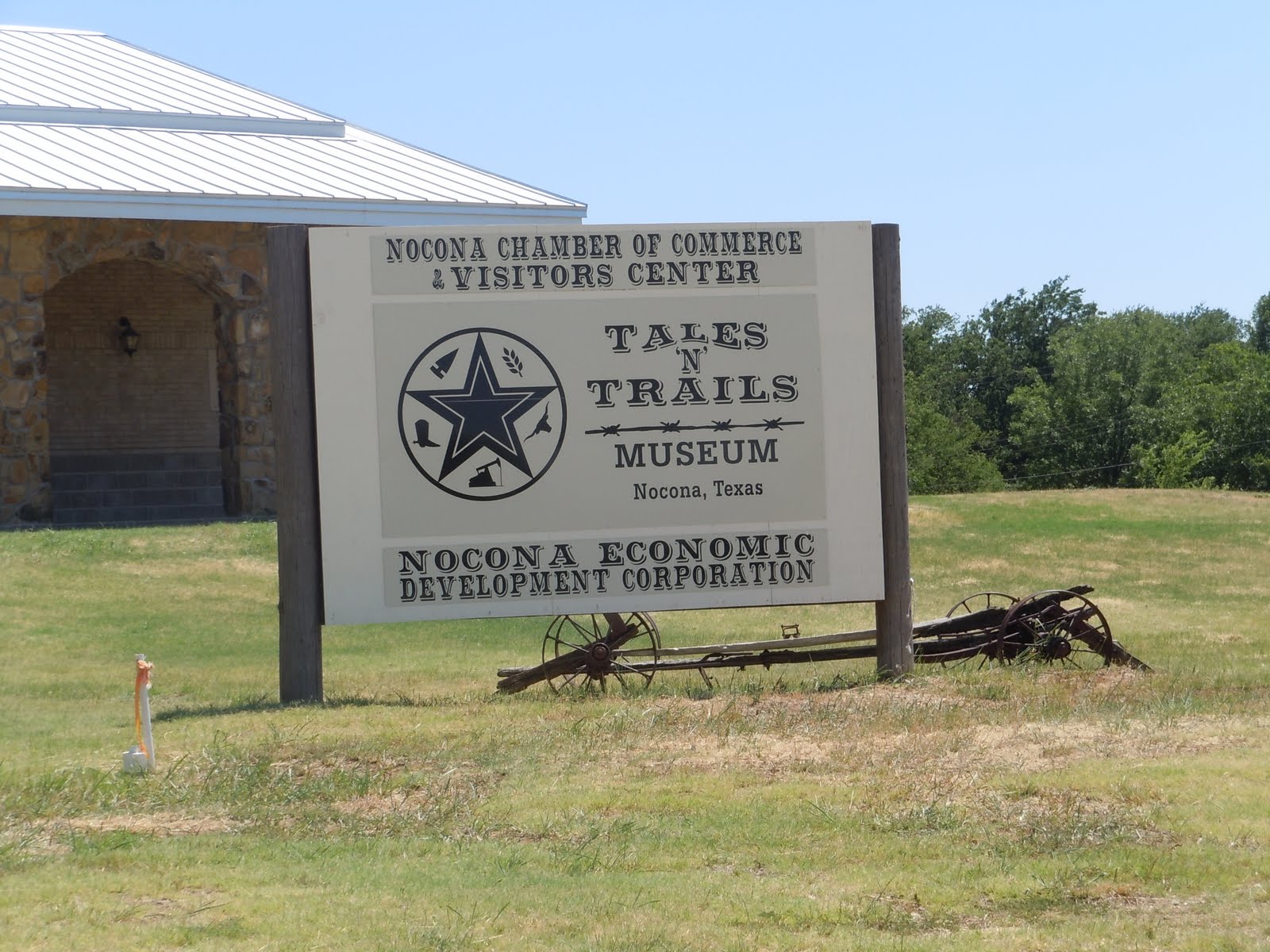
Since I first arrived at the office for the first day of work, Wayne Wood has been there to give me a hard time.  The Nocona Economic Development Corporations office is located on one side of the Tails and Trails Museum.  Wayne’s wife, Wanda, is  the head of the Nocona Chamber of Commerce, which is located in the Museum.  Wayne would come through the office and give me a hard time.  He would tease me about being a Red Raider, and every time he saw me he would ask me when I would run back to West Texas.  I knew it was all in good fun, but that’s still an interest way to get to know someone, or to let them know that you like them.  That’s what everyone kept saying:  that Wayne wouldn’t make fun of you unless he liked you, and if he didn’t like you, he would ignore you.  So I guess I’ll take a few jokes if it apparently equates acceptance in this crazy town.  Finally, at the rodeo, Wayne and I finally had a real conversation.  He had lived in Amarillo for a number of years, and so we compared notes on Amarillo and Lubbock. 

James pointed out a similar incident to me.  At the Texas Economic Development Corporations Meeting in Dallas, James introduced me to the Administrative Executive for the Wichita Falls EDC (which is only 45 minutes from Nocona), who is know as a pioneer in the field.  His response was to joke about my having to work with James (my supervisor), and telling me to call him if I need anything.  Again, he led off with a negative remark and condescending jokes.  A few minutes later, I was introduced to Joe Caballes, a gentleman from Austin and the Chairman of the Texas EDC Council.  His response was to tell me that I was in good hands with James.  The politician and big-city response is positive and encouraging (or in my opinion, a little ass-kissing and political), whereas rural Nocona people have a tendency to tear you down to compensate for their own feelings of insecurity. 
James and I discussed how to approach this negitavism phenomenon that is so virulent in the region.  We might have to basically re-train the people, end especially the leaders of Montague County to avoid negative language and to give constructive, positive feedback.  

Monday, June 13, 2011

The Ordinance


My first project that I have been working on was an Ordinance to designate the historic “main street” section of downtown Nocona as well as the modern thoroughfare along Highway 82, since that is where most visitors and passersby get their first real taste of Nocona. 

The City Council passed a similar ordinance trying to protect the original Clay Street block (essentially “Main Street”) a few years ago.  However, the original ordinance never had any “bite” to it.  There were no penalties, no strict guidelines, and no way to enforce the ordinance.  We also wanted to expand the area covered by the ordinance to include the streets and blocks surrounding Clay Street, as well as include the Highway 82 area within the city limits.

I began by researching similar projects undertaken by other cities.  There are different levels of the idea of creating a district that can be enforced by an ordinance that forces property owners to upkeep and use their properties for specified uses, and to protect existing structures.  While the buildings in the Clay street area are historical, many of them are being completely rebuilt instead of restored to their original shape, and the highway 82 area is not historically significant.  This makes it difficult to create a traditional Historic District as recognized by the Texas Historical Commission.  Plus, a historic district has much stricter guidelines than we wanted to impose on the property owners in Nocona. 

Instead, I found what are called Conservation Districts.  The City of Dallas uses them to conserve housing neighborhoods that exhibit certain architectural styles and have a certain character or cultural heritage that the city wants preserved.  I decided that a Conservation district – or in my case, two – would give me the ability to set some guidelines over what the owners of property in the districts could do with their buildings and property without having the requirements be too stringent.  So I created two different Conservation Districts:  The Downtown Nocona Conservation District, which goes along Highway 82 from city limit to city limit, and the Nocona Heritage Conservation District, which covers the Clay Street area and the surrounding blocks. 

It was a little difficult to write the ordinance because instead of creating a separate committee to overview applications for construction within the Conservation Districts, we decided to us the building Permitting Committee.  However, Nocona, being a small town, has never passed a building permitting code or process or a zoning ordinance.  The City Council is looking into passing the International Building Code, but has not yet.  So basically my ordinance is referencing a permitting committee that doesn’t exist yet.  

Tuesday, June 7, 2011

Introductions

Although I had driven through Nocona many times since Highway 82 is the main road I travel to go back and forth between my hometown of Sherman and Lubbock, I had never stopped in Nocona before.  However, about two weeks before my internship officially started, I was making the trek from Lubbock to Sherman, and decided to make a quick stop in Nocona to meet my future supervisor.

I arrived on May 31st to officially begin my internship.  Even though I arrived at 3 pm and only had 2 hours until the end of the workday, I consider that day my favorite example of the “rural” aspect of my internship thus far.  James, the director of the Nocona Economic Development Corporations (Nocona EDC), handed me a key to the office, and then told me to follow him around town so that he could introduce me to some folks.  We started our tour and introductions at City Hall, where I met the City Secretary.  However, the city manager was not in the office, as he was on the golf course – meaning he was the maintenance man for the golf course!

We then drove around the corner to the main street area.  But on the way, we saw the mayor in his car in line at the drive-through bank, so we stopped (in the middle of the street), got out of our cars, and walked over to say hello. 

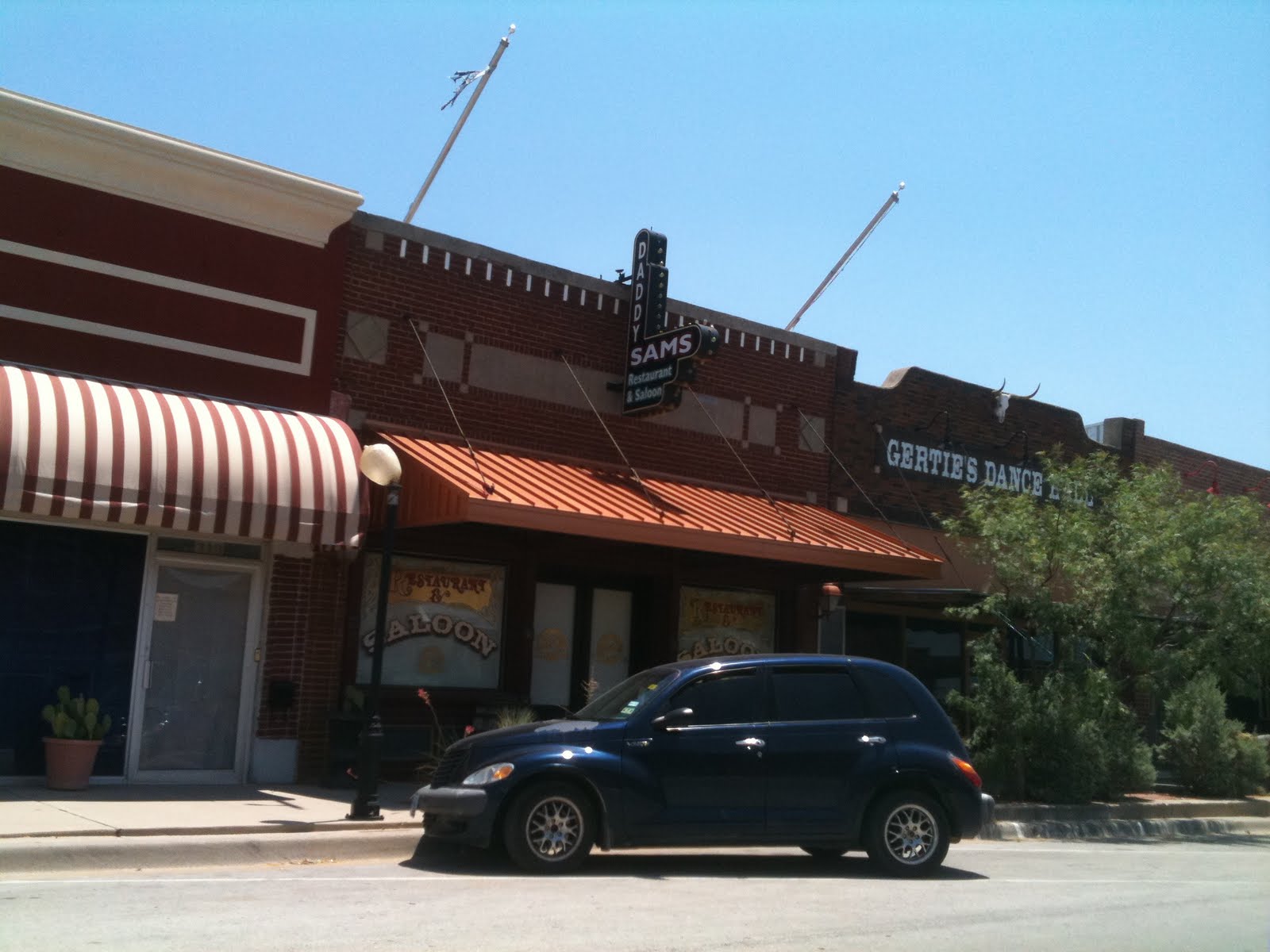
We then parked and walked down Clay Street (essentially Main Street) to meet the major players in the revitalization of downtown.  We met the mayor’s brother, who had bought and restored a few buildings.  First, he opened Daddy Sam’s Saloon, which serves as a meeting place for concerts and events in the town.   We also met the local boot maker, who carries on the original Nocona Boots tradition by had crafting leather.  Finally, I got to meet with one of the two lawyers in town, a father and daughter team whose office is housed in an old hotel.  The daughter even took me upstairs and showed me the old run-down hotel, which is a sad sight as the only two-story building in Downtown Nocona.  As we talked, she enlightened me about the nuances of the small community.  She explained that she wanted to fix up the old hotel on the second floor of the law office, but that her father and the two other older gentlemen that own the building refuse to spend money to prevent the roof from caving in, which will eventually happen.  She also explained the dynamics of the legal community to me.  There are two lawyers in Nocona, and nine in Montague County.  One is the current judge, who is retiring.  There must be a District Attorney, a public defender, and a new judge, leaving only five other attorneys without a public position. 

My first three full days working, I began working on my first project for Nocona:  a city ordinance that would give the building permitting committee oversight when a new or existing building would be constructed or altered.  I started by looking at the old ordinance that the city passed a few years ago, attempting to do the same thing, but that did not have any “bite” or enforcement.  Next, I researched different possible ordinances that other cities had already passed.  Then, I began using a model ordinance and adjusting the ordinance to meet the needs of Nocona. 

On Thursday evening, I got to attend the Montague County Leadership Creative meeting.  There are three incorporated communities in Montague County:  Bowie, Nocona, and Saint Jo.  There are also several unincorporated communities.  There is a major rivalry between Bowie, the economic and population center of the county, and Nocona, most likely due to a long football rivalry.  In an effort to strengthen inter-community ties, leaders from each town began meeting to try to figure out how to bring the communities together.  This was the third meeting of the group.  The difficulty lies in the established rivalries and the inability for the communities to see how interdependent they are on each other.  The group even discussed how the communities resist change because “that’s the way it’s always been done.”  The group has to figure out how to change the thinking of the public.  The group is discussing the one factor that unifies the entire county – the Chisholm Trail – and the idea of raising a new generation of young leaders that are comfortable with working together.  The group discussed creating a historical tour focusing on the Chisholm Trail, as well as a new leadership group for young individuals representing the different communities in the county.